
Marcus
Operations Specialist
I manage projects, tasks, and operational workflows across your organization: surfacing bottlenecks, tracking dependencies, and ensuring nothing slips through the cracks.
34 ToolsExplore

AI-Native Enterprise Intelligence Platform
A $2.5 Trillion Problem.
The Solution

OXFlow provides the Contextual Intelligence Platform that enterprise AI requires.
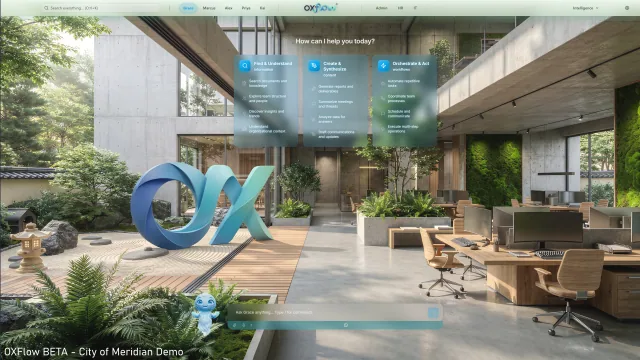
OX stands for Operational Experience. OXFlow doesn't just capture organizational knowledge. it predicts organizational futures, builds decision matrices, measures mission drift, and adapts to your enterprise in real time.
Organizational intelligence compounds through use. AI authority is calibrated by demonstrated mission fidelity. The governance architecture metabolizes its own decisions. a closed-loop system that gets smarter as it operates.
The Flow
Organizational intelligence only compounds when it keeps moving. This is the metabolic flow underneath OXFlow; continuous circulation that turns everyday signals into governed and contextual intelligence instead of a static archive.
Sources
Outputs
Metabolic Layering
OXFlow begins from a broad, cross-domain semantic foundation: a shared map so you are not defining meaning from scratch on day one. Signal flows in from connected tools, conversations, and documents; what your organization uses and validates rises in prominence over time.
What earns trust stays active. What goes stale fades. The graph metabolizes noise so the map tracks reality, not last quarter's slide deck.
Two living models, paired by design. The Organizational Digital Twin captures enterprise-wide reality: people and structure, operations and data, strategic context. The Individual Digital Twin tracks each employee: role, authority, MFR score, concept affinities, and interaction history. The bridge between them is what makes every response contextual: grounded in both enterprise posture and personal identity.
This dual-twin architecture is what separates contextual intelligence from generic AI. Every answer respects organizational policy and individual context simultaneously.
Mission Fidelity Rating is OXFlow’s answer to a question every buyer eventually asks: how do we know assistance matches what we are trying to do? A live alignment signal informs how much the system abbreviates versus escalates: governed authority, not a one-time badge.
More latitude where alignment is consistently demonstrated. Structured guidance and review where it is not. Trust compounds the same way people earn it: through evidence over time.
Production reality drifts: priorities change, noise accumulates, automation ages. OXFlow is built to refresh, detect shift, and retire what no longer earns confidence: metabolic maintenance instead of a brittle knowledge dump.
The longer this flow runs in your environment, the more contextual and governable your compounding intelligence becomes.
This is the metabolic system. Above it sits a small team of specialized agents: each with a clear job in keeping the system contextual, governed, and usable.
Hyper-Contextual Output
Five specialized agents, each owning a business domain, coordinated by a central orchestrator. Not a chatbot. An enterprise intelligence system.

Chief Orchestrator
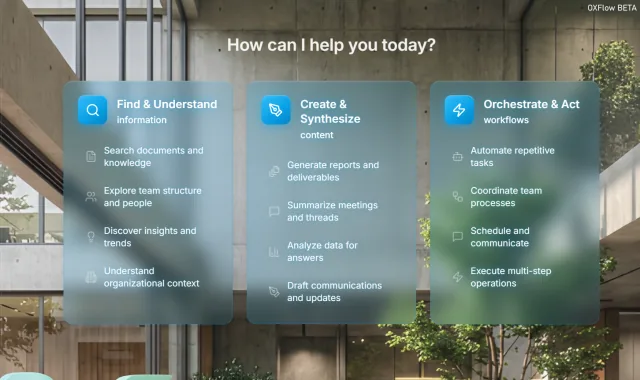
Grace represents a fundamentally new approach to enterprise AI—not a chatbot or copilot, but an executive intelligence system and strategic advisor. Grace orchestrates understanding, reasoning, governance and execution across your entire organization. Grace operates at the strategic and tactical levels simultaneously.
Enterprise Memory
Grace remembers every decision, document, and conversation across your org. Ask about something from 18 months ago: she retrieves it with context.
Agent Coordination
Marcus, Priya, Alex, and Kai each have deep domain expertise. Grace knows when to route to one agent vs. synthesizing answers from multiple.
Continuous Calibration
Grace learns from your feedback. When you approve/reject actions, Grace adjusts future routing and approval thresholds: getting smarter about your organization's norms.
Operations Specialist
I manage projects, tasks, and operational workflows across your organization: surfacing bottlenecks, tracking dependencies, and ensuring nothing slips through the cracks.

Finance & Compliance Specialist
I manage invoices, expenses, cash flow, and financial forecasting: ensuring you stay on budget, get paid on time, and see financial risks before they impact operations.

CRM & Sales Specialist
I manage contacts, deals, pipeline, and all customer communications: ensuring no opportunities slip through cracks, relationships stay strong, and your inbox stays focused.

Marketing & Social Manager
I manage campaigns, creatives, audience insights, and channel performance: ensuring your marketing drives measurable growth and stays aligned with revenue goals.
Where intelligence becomes infrastructure
Five integrated surfaces. One intelligence layer. Every interaction compounds.
Every view is intelligence-aware. MFR signals, risk indicators, and Grace recommendations can surface where teams work.
The platform meets every role where they work. Intelligence tuned for how executives, managers, analysts and individual contributors actually operate.
Click any card to explore capabilities
5 capabilities
5 capabilities
6 capabilities
5 capabilities
Self-regulating intelligence with human oversight. Tap a card to see a concrete scenario.
These capabilities represent a shift from static AI tools to adaptive organizational intelligence. OXFlow doesn’t just execute. It learns and adapts while keeping humans in the loop at critical decisions.
Forecasts that improve over time, with calibrated confidence and closed-loop accountability.
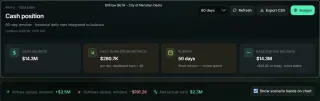
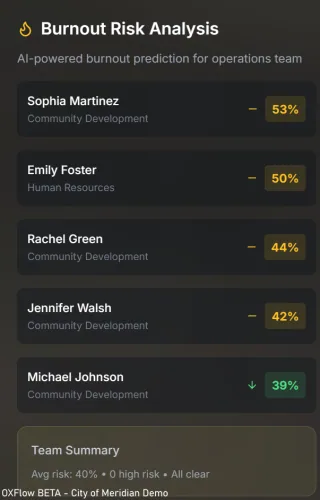
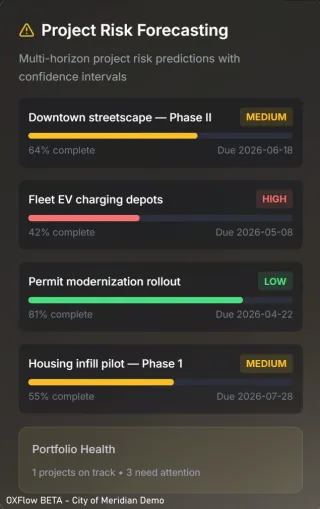

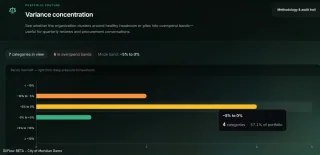
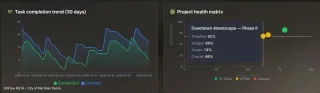
Intelligence without execution is just interesting data. The workspace is where organizational intelligence becomes action: every tool connected to the same cognitive foundation, every interaction making the system smarter.
The Governance
Enterprise AI requires more than capability. It requires accountability. OXFlow provides the governance layer that AI regulation will demand and that organizational trust already requires.
AI does not receive authority by default. It earns it through demonstrated organizational fidelity. Five graduated tiers calibrate how much latitude the system receives: from full human oversight during onboarding to autonomous execution where alignment is consistently proven.
Every response carries a unique reasoning trace. SHA-256 hash-chained audit trails create a tamper-evident record across all 13 pipeline stages: what data was used, which policies were checked, what confidence was assigned, and who approved it. Forensic-grade transparency by default.
Three-tier automation controls govern every action: Allow (agent acts within policy), Require Approval (agent recommends, human decides), or Deny (action blocked). You define the boundaries per action, per agent, per role.
The system tells you when it does not know. Calibrated confidence scoring quantifies certainty on every output. When confidence drops below threshold, OXFlow discloses uncertainty rather than guessing. Prediction accuracy is tracked through closed-loop scoring and fed back into calibration.
OXFlow monitors OXFlow. The same governance architecture that watches your organization watches the platform itself: mission alignment, concept growth, prediction calibration, and drift detection all run on the system that builds the system. When we say the architecture metabolizes its own decisions, the logs prove it.
AI regulation is not coming. It is here. EU AI Act high-risk provisions take full effect August 2026. US executive orders mandate safety frameworks for enterprise AI. OXFlow was architected for conformity assessments, human oversight documentation, and accuracy monitoring from day one. SOC 2 Type I control matrix completed.
Governance is not a feature checkbox. It is the infrastructure that makes every other OXFlow capability trustworthy. The system does not ask enterprises to trust AI blindly: every recommendation has a reasoning trace, every action has an approval gate, every agent has a boundary, and every user has a scope.
Solutions by Department
See how metabolic intelligence surfaces insights that traditional AI tools miss.
Slide 1 of 8: Which strategic bet has the highest mission-fidelity ROI?
Concrete outcomes across every business function, grounded in the same metabolic intelligence that powers the department scenarios above.
From reactive management to predictive leadership
From reactive management to predictive leadership
Continuous improvement embedded in operations
Audit-ready by architecture, not by checkbox
Evidence-based pipeline, not opinion-based forecasts
Attribution paths from creative to revenue
Institutional memory that survives turnover
Multi-signal diagnosis, not log walls
Each insight requires capabilities that Copilot, Glean, and traditional AI cannot provide. OXFlow does not only retrieve documents: it governs decisions, predicts drift, and remembers your lessons.
AI Governance as a Service
Most enterprise AI fails because it retrieves documents instead of governing decisions. OXFlow is the only platform with mission-aligned autonomy from day one.
10/10 capabilities native
Closest competitor: 1/10 native
Click any row to compare details
Microsoft Graph maps people, files, meetings and activity signals but not organizational concepts or domain knowledge
Enterprise Graph maps relationships between people, projects, teams and processes via ML inference across 100+ connectors
CMDB tracks assets and config; Knowledge Management stores articles but no semantic concept graph
Foundry Ontology: semantic objects, properties, links and actions; powerful but manually curated per deployment
CRM object model + Data Cloud unified profiles; connects data across systems but no cross-domain concept graph
UCIM: 40,619 base concepts, 10 domains, 6-state lifecycle
Every interaction trains OXFlow's concept graph. By Month 12, you'll have 10,000–20,000 proprietary concepts competitors can't replicate.
Every week, your competitive advantage compounds. By Month 12, competitors cannot replicate your institutional knowledge.